Friday, June 20, 2014

Why I move: Aikido


My apologies for not posting in a while: We took an extended weekend trip to the coast primarily for an aikido weekend. We spent four days in Monterey, California to enjoy the ocean, the world famous Monterey Bay Aquarium, enjoy farm fresh vegetables from the Salinas Valley and fresh fish, and three days of aikido.

Because of that fabulous weekend, I think this will be the perfect opportunity to continue my “Why I move” series, this time focusing on aikido.

aikido staff takeaway
As you probably have read in some of my previous posts, my aikido practice has been a major part of my life. I have been training longer than what I’d like to admit (only 12 years, longer if you count the year or two before graduate school) and am now a second-degree black belt. However, in some ways, there are still times when I feel that I am a beginner.

Aikido was my primary exercise when I was in dialysis. Back then, I could only train twice a week and was tired after that. Now, I am training at my normal schedule, three times a week, and can squeeze in a day or weekend if I need to.

I enjoy aikido because it provides me with a great way to release stress. I am not sure what it is, but after class, my mood is usually better and I feel happier.  Even if I feel tired before class, after class, I feel energized.

Aikido also improves my mental fitness. I saw a piece on TV that keeping your brain active and learning new concepts actually improves your brain and memory. Aikido definitely qualifies as that: although I’ve practiced for a while now, there are still new terminology, techniques, and combinations to remember. I really enjoy the blend of physical exercise, language, and patterns since I have been drawn to learning new languages. The exercise is a big bonus.

The relationships that developed while in aikido have been a major plus in my life. We have celebrated a lot of happy memories like marriages, engagements, and new babies. We have also been there for each other through sad events. In fact, my aikido family has been extremely supportive during my time on dialysis and through my recovery. They are very protective of me and that I do not injure my new kidney and my fistula. In the dojo, we take care of each other and are protective of our training partners. This is one of the principles of aikido. Also, we want our partners to come back and train some more.

Of course, aikido also benefits me physically. I think it is not only because of the exercise, but also because my body seems to function a lot better after class. As an example, if I feel like I am retaining water, after class, it seems resolved. As the Japanese would say, my ki or life force seems to be flowing better. That is actually what the “ki” in aikido means: Aikido is the way of harmony in energy or spirit.


before test

Aikido was one of the things that helped me cope with dialysis and now as I learn my boundaries with a new kidney. I feel that as I train more: I feel more aware of my body and its limits. Although one may be hesitant to try it because it is a martial art and may be challenging, I highly recommend it to anyone. It will help you in body, mind, and spirit.

Just try it… you will enjoy it!

If you enjoyed this article, you may enjoy the others from my "Why I move" series:


Tuesday, June 3, 2014

Kidney Walk 2014


The San Francisco Kidney Walk was last weekend. My Hubby and I attended and we had a great time.

It was also my first time “live tweeting” an event. It was a lot of fun. It sort of brought out my inner Lois Lane. I felt like a journalist or a social media expert – cool.

I posted a lot of pictures on Twitter. But for those who don’t use Twitter, I am featuring a selected few in this post, including some that I did not tweet, so you can participate virtually.

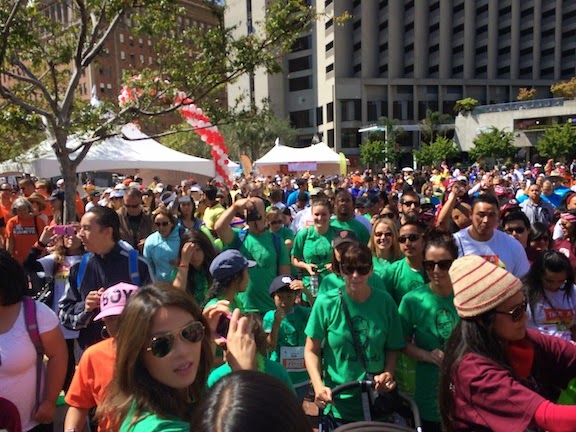
The Kidney Walk "Health Fair" and Mission Zone: Great turnout today. It's also the perfect day in San Francisco for a walk.

Kidney Walk Health Fair

The bibs that we picked up for the walk: one for me, one for my Hubby, my hero.


Inspirational speech and performance by Scott MacIntyre, American Idol Finalist. He is legally blind, and at 19 years old, was diagnosed with kidney failure. Thanks to the wife of one of his music teachers, he received a kidney. His story and song "I am Hope" are inspirational. I hope it gives hope to the thousands of people waiting for a kidney.


Scott MacIntyre Presentation


Our walk starting: The crowd is ready to go. 

Ready to start

Cheerleaders motivating us. In the background, you can see how long the procession is. 

Kidney Walk Cheerleaders

The Walk Back: You can see how far we walked, the Ferry Building clock tower is in the background (about a mile and a half away). We walked about 3 miles.

Kidney Walk - Walk Back to Ferry Building

Almost there: More cheerleaders motivating to the last steps. 

KW Finish Line Cheerleaders

Made it! Finish Line! Here's the obligatory selfie.


Overall, it was a wonderful day and lots of fun. The crowd was energized and ready to walk. This was not a competitive walk. Folks were walking at their own pace and enjoying a beautiful San Francisco day. The goal really was and will continue to be community building, support, and fellowship. 

My husband and I will be doing it again and already making plans for next year's walk and fundraising goals. I hope this post showed the participation, excitement, and joy in the crowd. Hope you will join us in the walk next year and in the fight against kidney disease. 


Sunday, May 11, 2014

Why I move: Walking


I recently was named Move It Monday ambassador, so I thought I would do a series on the different ways that I move. Moving is very important to me since it is my opportunity for me to exercise and maintain my health. Since I am training for the Kidney Walk, I will start the series with walking.

walking path
Get out and walk
Walking has become one of primary methods of exercise and one of the easiest. I think I said it once or twice "one foot in front of the other." All I need to do is find time, put on my sneakers, and go outside. I probably do this four days a week: most of the time just for a short time, but once a week almost hour and half and walk for 3 miles. That is my maximum so far.

I find that when I walk, my blood pressure drops 5 to 10 points. As we all know by now, maintaining a healthy blood pressure is important to maintaining kidney health. So I make it a point to walk almost every day, even it is just for 20 minutes. I walk slow, so I have recently upped it to 25 minutes to make it more than a mile. I am hoping that someday, I can walk a bit faster.

Walking also clears my head. When I walk, I put problems and issues in my subconscious and enjoy my surroundings. During my walk, I look at the Mt. Diablo and surrounding hills, what flowers are blooming, and what critters are running around. Today, I saw a quail family moving from one hiding place to another – what a treat. You never know what you’ll see.

During the workweek, I try to walk around lunchtime to reset for the afternoon. It also gives me a much needed boost of energy for the afternoon.

Walking also improves my endurance. I am finding that I can walk a bit faster now and still trying to shave some time. I did try jogging for a bit to increase the intensity, but I am finding my knees are no longer up for that. So, it is back to walking for me... for now.

Although I try to walk 20-30 minutes in one shot, sometimes it is not possible because of my workday – especially when I go in the office. At work, I try to take the stairs and take short breaks in between things. For a while I was even wearing a pedometer to make sure I got close to about 10,000 steps.

I did not walk before the transplant, but my recovery routine made it a daily habit. I remember just starting with laps around the hospital section I was in, then it was around our complex, and now to fountain and back (that’s my three-mile route).  

So, get outside and walk. You’ll love it!


If you enjoyed this article, you may enjoy the others from my "Why I move" series:

Tuesday, April 29, 2014

Side Effects

Image courtesy of Grant Cochrane/
FreeDigitalPhotos.net
I guess I spoke too soon about not having any side effects from my medications.

I have been seeing signs of side effects. My biggest concern is I am now extremely sensitive to salt. Every time we dine out, I gain at least two pounds. Before transplant, this did not happen to me (or so I would like to think). I could eat out at a restaurant or at the cafeteria, and not worry about bloating. These days, even at the end of the day, I can feel that I am retaining water. It can get so uncomfortable that I often have to wear loose pants (I cannot wait until it is warm enough that I can wear a skirt). If we get away for the weekend, forget it – It’s an automatic five pound swing.

I am not too concerned about the clothes. I like loose-fitting clothing anyways (except for the occasional skinny jeans). My primary concern is that the constant weight fluctuations cannot possibly be healthy for me.

I am also very tired in the morning and get really hit with a huge mid-afternoon slump. I used to think that this was not a big deal since a dose of caffeine usually puts me back on track. However, lately, I have been getting so tired that I cannot get up in the morning. Back when I was on dialysis, I felt that had more energy in the morning than now.

Fortunately, it can be fixed by a cup of coffee or chai. My lethargy when I was dialysis can last the entire day.

After my recent visit with my transplant nephrologist, I think we figured out part of the reason. One of my blood pressure medications – Minoxidil – is sensitive to sodium and therefore causing water-retention.  It may also be the culprit for my morning lethargy, but neither the doctor nor the nurse mentioned that the medication is causing that. Minoxidil does cause hair to grow in places where you do not want it (It is commonly known as Rogaine).

Unfortunately, now that it is a year after my transplant, my blood pressure medication is managed by my primary nephrologist. I now have three doctors: the transplant nephrologist, my primary nephrologist, and my primary care doctor. It really does make managing my medication a bit complicated. Don’t get me wrong, I am grateful for having so many doctors, each with their own specialty, managing my care.

I did e-mail my primary nephrologist to ask for his opinion – possibly lowering the dosage. However, all he did was prescribe a Lasix, a potent diuretic which I am a bit hesitant in taking. I had a bad experience with diuretics, and I really do not want to take one more pill. Perhaps we can present our case better when we meet him in person.

So in the meantime, I am taking some steps to minimize the side effects. We minimize dining out to reduce our sodium exposure. It still takes me 2-3 days to remove the weight that I gain when we eat out.

I am also allowing myself time to get up: I gradually sit up until my body is fully awake. So far, it seems to be working.

I guess we wait… until my next doctor visit.

What do you all think? Let me know; I am very interested in your input and feedback.

Sunday, April 13, 2014

TAX DAY!!!

Finally taxes are done!  We know it’s almost last minute, but we had a good excuse. Well, at least we did this year, but we also procrastinated, which is probably a topic for another day (or not).

1040 with pen
Our primary challenge this year is that I was on disability last year. We did not know how to handle the proceeds from that period. Although I used TurboTax, I usually just let things import from last year, enter my W2 and other income information (like interest and dividents) and let TurboTax do its thing. We have a relatively simple return, since we did not have enough medical expenses (Thank you Medicare and additional insurance) or deductions to itemize. Also, we did not get a tax-related statement from EDD. Not sure what to do. 

I googled what is usually done and ran into a Form 1099-G for disability payments. We did not get one, so we (more I) were on the verge of panicking. We need to file in three weeks, and we cannot wait for the form. Fortunately, the calm one in our household (Hubby) said that if needed, we can simply file for an extension. I’m glad he helped me think through this.

We called EDD and listened to the long message (twice!) The first time the telephone query system said that there is no 1099-G in record for me. Now, we are confused.

We called my HR department and they said I should have a claim. The lady was helpful and gave me my claim number, both for our company and EDD. 

We called EDD again (and listened to the long message one more time) and finally talked to a live person. He told us that the proceeds during my disability is not taxable, since these are insurance payments. My husband and I were elated. No forms to wait for – at least for California!

Because work has been somewhat hectic, I decided to wait for last weekend to finish our taxes. Should not be too bad, right? We’re almost done; all we need to do is print.

However, upon detailed review – I saw that the state return is off – way off. OMG! What could be wrong? I felt like an accountant going through the forms in detail (which is okay since I am OCD that way). After a thorough review, I realized that TurboTax defaulted to my taking the whole year off.

I did both the Federal and State interview and found where I could plug in the amount. Fortunately, we saved all of the statements from EDD and I calculated the total amount. We checked the form for errors, printed, and DONE! Hubby mailed it off the next day.

Thank God I caught the discrepancy.  Lessons learned in this exercise: disability disbursements are not taxable in the state of CA (since these are deemed as insurance payments) and when there is something new in your taxes/life, do the TurboTax interview – it will save you considerable stress. I am hoping that someday somewhere (in CA), someone can benefit from my stress.

And of course, don’t procrastinate… but that is a subject for another post.